Advanced Fire Prevention Strategies for Facilities Course
This course offers in-depth knowledge and practical strategies for implementing advanced fire prevention measures in facilities. It is ideal for safety professionals, facility managers, and anyone responsible for ensuring fire safety. The course stands out for its focus on cutting-edge fire prevention techniques and its direct applicability to various workplace settings. Participants will gain valuable insights, skills, and certifications to enhance their career prospects in the health and safety industry.
- Duration
- Self-paced
- Access
- 6 months
- Assessment
- Online multiple choice
Course at a glance
- What it is
- An online fire safety course with an independent certificate of completion.
- Who it's for
- This course is designed for safety professionals, facility managers, health and safety officers, fire safety officers, and individuals responsible for fire prevention in facilities.
- What you'll be able to do
- Apply what you learn in the course outcomes to your workplace.
- Time and cost
- Self-paced study. $199.99, one payment.
- Recognition
- This course is CPD-accredited by CPDcourses.org.uk. On successful completion, you receive a certificate of completion from healthsafetycourses.org. This is professional development training and is not an Ofqual-regulated qualification or an IOSH or NEBOSH award.
What you'll learn
By the end of the course you will be able to:
- Implement advanced fire prevention strategies in facilities
- Evaluate and mitigate fire risks effectively
- Develop comprehensive fire safety plans tailored to specific facilities
- Conduct thorough fire safety inspections and audits
- Lead fire safety training programs for facility staff
Study materials and assessment
What's included
Study materials include course handouts, reference guides, case studies, and online resources to support learning.
How you're assessed
Students will be assessed through quizzes, assignments, and a final exam to demonstrate their understanding and application of advanced fire prevention concepts.
Course modules
5 modules
Module 1: Understanding Fire Behavior
This module explores the science behind fire behavior, including ignition, spread, and extinguishment.
- Principles of combustion
- Fire dynamics
- Types of fire and extinguishing agents
Module 2: Fire Risk Assessment and Management
Participants will learn how to assess fire risks, develop risk management strategies, and prioritize control measures.
- Fire risk assessment methods
- Hierarchy of control measures
- Emergency response planning
Module 3: Fire Prevention Systems and Equipment
This module covers the selection, installation, and maintenance of fire prevention systems and equipment in facilities.
- Fire detection and alarm systems
- Automatic sprinkler systems
- Fire suppression systems
Module 4: Emergency Evacuation Procedures
Participants will understand the importance of effective emergency evacuation procedures and how to develop and test evacuation plans.
- Evacuation planning
- Emergency communication systems
- Drills and exercises
Module 5: Fire Safety Training and Awareness
This module focuses on designing and delivering effective fire safety training programs to ensure staff are prepared for emergencies.
- Training needs assessment
- Fire safety drills
- Employee awareness programs
How to carry out a fire risk assessment
The five-step method in the UK government's fire safety guidance, which the course teaches in detail.
- Identify the fire hazardsSources of ignition, sources of fuel and sources of oxygen.
- Identify people at riskStaff, visitors and anyone especially at risk, such as people who need help to evacuate.
- Evaluate, remove, reduce and protect from riskRemove or reduce hazards, then put fire precautions in place to protect people.
- Record, plan, inform, instruct and trainRecord the significant findings, make an emergency plan, and train your staff.
- ReviewReview regularly, and whenever something significant changes.
Fire risk assessment and the law
- Regulatory Reform (Fire Safety) Order 2005In England and Wales, the responsible person must carry out a suitable and sufficient fire risk assessment and keep it under review.
- Building Safety Act 2022 (section 156)Since 1 October 2023, all responsible persons must record the full assessment in writing and record who carried it out.
- Fire Safety Act 2021Confirms the Order covers the structure, external walls and flat entrance doors of multi-occupied residential buildings.
- Fire (Scotland) Act 2005Sets equivalent duties for premises in Scotland.
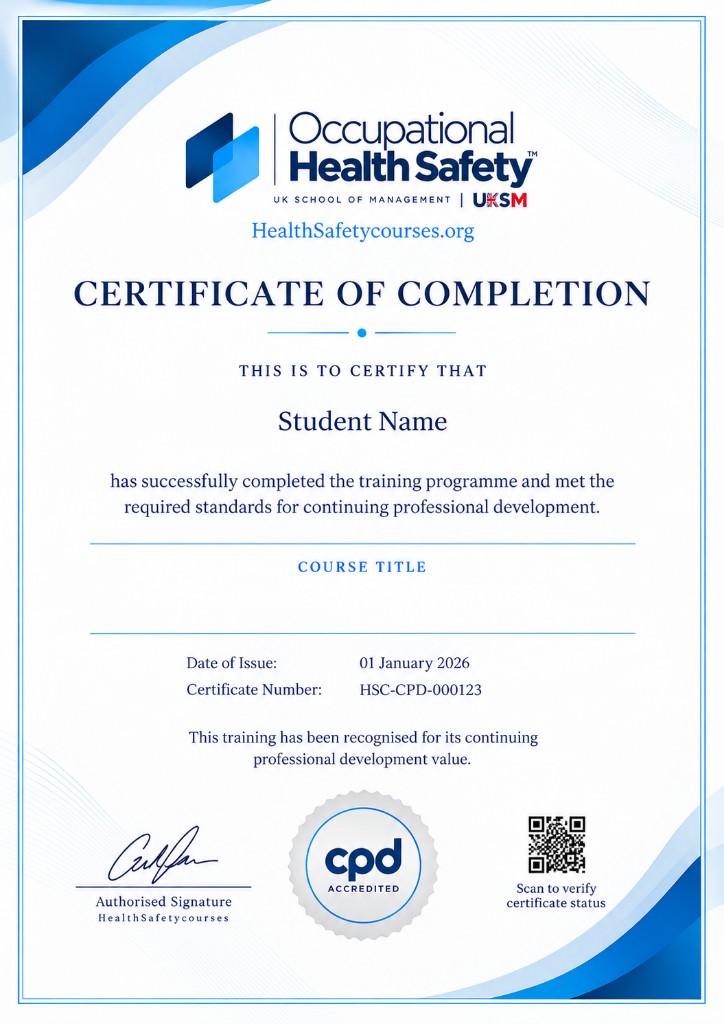
Fire risk assessment certificate
Participants who successfully complete the course and pass the assessment will receive a certificate in Advanced Fire Prevention Strategies for Facilities.
- Unique certificate ID and QR code
- Online verification anyone can use
- Shows the course title, study hours and date for your CPD record
Sample certificate — Advanced Fire Prevention Strategies for Facilities
 Advanced Fire Prevention Strategies for Facilities
| Feature | This course | Level 3/4 fire risk assessment qualification |
|---|---|---|
| Best for | Assessing and reviewing your own workplace | Becoming a professional fire risk assessor |
| Recognition | Independent certificate, not regulated | Regulated qualification from an awarding body |
| Time | Self-paced part time | Several days of training plus assessed reports |
| Assessment | Online multiple choice | Exams and practical fire risk assessments |
| Start | Any day, fully online | Set course dates |
Course fees
Fire risk assessment course FAQs
Is this course suitable for beginners in fire safety?
While some basic knowledge is recommended, the course covers advanced topics in an accessible manner suitable for learners at various levels.
Will I receive a certificate upon completion?
Yes, participants who successfully complete the course and pass the assessment will receive a certificate in Advanced Fire Prevention Strategies for Facilities.
Are there opportunities for networking with industry professionals?
Yes, the course provides networking opportunities through group discussions, interactive sessions, and access to industry experts.