
Developing Fire Safety Protocols for Public Buildings Course
This course is designed to equip professionals in the health and safety industry with the knowledge and skills to develop effective fire safety protocols specifically for public buildings. Ideal for safety managers, architects, engineers, and building managers, this course provides a unique focus on practical applications and real-world scenarios. Participants will benefit from enhanced safety compliance, risk assessment proficiency, and emergency response readiness.
- Duration
- Self-paced
- Access
- 6 months
- Assessment
- Online multiple choice
Course at a glance
- What it is
- An online fire safety course with an independent certificate of completion.
- Who it's for
- Safety managers, architects, engineers, building managers, safety officers, and anyone involved in ensuring fire safety in public buildings.
- What you'll be able to do
- Apply what you learn in the course outcomes to your workplace.
- Time and cost
- Self-paced study. $199.99, one payment.
- Recognition
- This course is CPD-accredited by CPDcourses.org.uk. On successful completion, you receive a certificate of completion from healthsafetycourses.org. This is professional development training and is not an Ofqual-regulated qualification or an IOSH or NEBOSH award.
What you'll learn
By the end of the course you will be able to:
- Design comprehensive fire safety protocols for public buildings
- Conduct thorough risk assessments to identify fire hazards
- Implement preventive measures and emergency response plans
- Ensure compliance with fire safety regulations and standards
- Enhance safety culture and awareness within public building environments
Study materials and assessment
What's included
Course materials include lecture notes, case studies, practical exercises, and reference guides on fire safety regulations and best practices.
How you're assessed
Students will be assessed through quizzes, practical assignments, and a final project where they develop a comprehensive fire safety protocol for a public building.
Course modules
4 modules
Module 1: Introduction to Fire Safety in Public Buildings
This module provides an overview of fire safety regulations, common fire hazards in public buildings, and the importance of proactive safety measures.
- Legal requirements and standards
- Fire risk assessment
- Fire detection and alarm systems
- Emergency evacuation procedures
Module 2: Developing Fire Safety Protocols
In this module, participants will learn how to create tailored fire safety protocols, including establishing roles and responsibilities, conducting drills, and ensuring compliance.
- Roles and responsibilities
- Fire safety training
- Drills and exercises
- Compliance monitoring
Module 3: Fire Prevention and Control Measures
This module focuses on preventive measures such as fire compartmentation, fire extinguisher use, and fire suppression systems to minimize fire risks.
- Fire compartmentation
- Fire extinguishers and their types
- Automatic fire suppression systems
- Fire safety signage
Module 4: Emergency Response Planning
Participants will learn how to develop effective emergency response plans, including communication strategies, assembly points, and post-incident procedures.
- Emergency response plan development
- Communication strategies
- Assembly points and evacuation routes
- Post-incident procedures
How to carry out a fire risk assessment
The five-step method in the UK government's fire safety guidance, which the course teaches in detail.
- Identify the fire hazardsSources of ignition, sources of fuel and sources of oxygen.
- Identify people at riskStaff, visitors and anyone especially at risk, such as people who need help to evacuate.
- Evaluate, remove, reduce and protect from riskRemove or reduce hazards, then put fire precautions in place to protect people.
- Record, plan, inform, instruct and trainRecord the significant findings, make an emergency plan, and train your staff.
- ReviewReview regularly, and whenever something significant changes.
Fire risk assessment and the law
- Regulatory Reform (Fire Safety) Order 2005In England and Wales, the responsible person must carry out a suitable and sufficient fire risk assessment and keep it under review.
- Building Safety Act 2022 (section 156)Since 1 October 2023, all responsible persons must record the full assessment in writing and record who carried it out.
- Fire Safety Act 2021Confirms the Order covers the structure, external walls and flat entrance doors of multi-occupied residential buildings.
- Fire (Scotland) Act 2005Sets equivalent duties for premises in Scotland.
Fire risk assessment certificate
Upon successful completion of the course and assessment, participants will receive a certificate of proficiency in Developing Fire Safety Protocols for Public Buildings.
- Unique certificate ID and QR code
- Online verification anyone can use
- Shows the course title, study hours and date for your CPD record
Sample certificate — Developing Fire Safety Protocols for Public Buildings
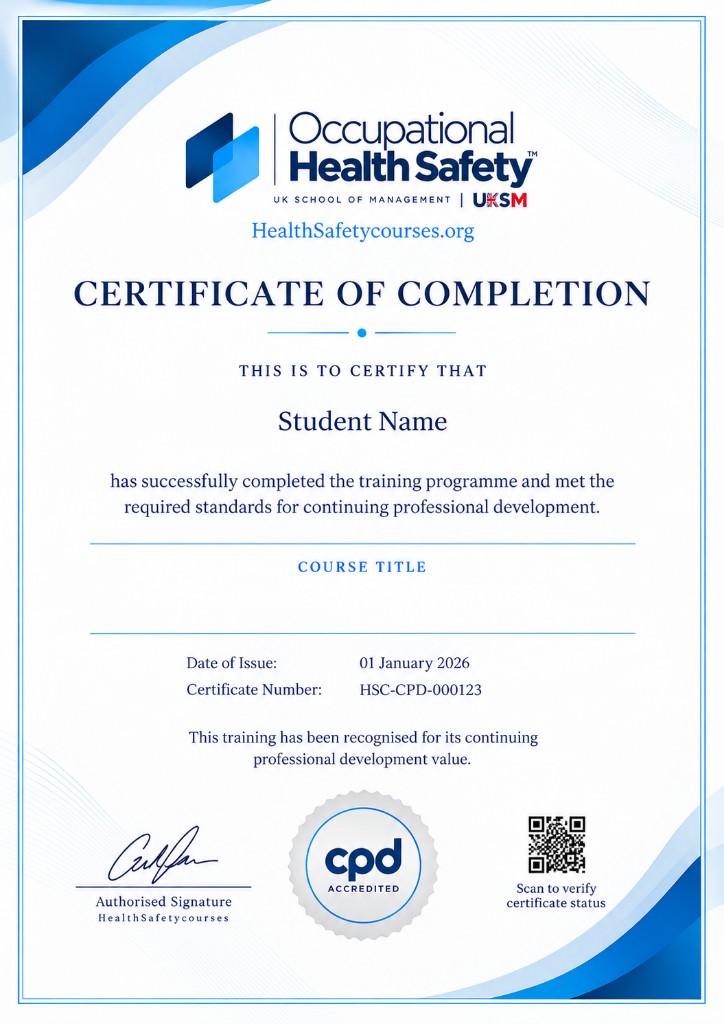 Developing Fire Safety Protocols for Public Buildings
| Feature | This course | Level 3/4 fire risk assessment qualification |
|---|---|---|
| Best for | Assessing and reviewing your own workplace | Becoming a professional fire risk assessor |
| Recognition | Independent certificate, not regulated | Regulated qualification from an awarding body |
| Time | Self-paced part time | Several days of training plus assessed reports |
| Assessment | Online multiple choice | Exams and practical fire risk assessments |
| Start | Any day, fully online | Set course dates |
Course fees
Fire risk assessment course FAQs
What is the duration of the course?
The course duration is 8 weeks, with a flexible learning schedule to accommodate working professionals.
Are there any practical exercises included?
Yes, the course includes practical exercises and simulations to apply theoretical knowledge in real-world scenarios.
Will I receive a certificate upon completion?
Upon successful completion of the course and assessments, participants will receive a certificate of proficiency in Developing Fire Safety Protocols for Public Buildings.