Effective Fire Prevention in Residential Settings: Practical Implementation Techniques Course
This course provides comprehensive training on practical fire prevention techniques in residential settings. It is designed for health and safety professionals seeking to enhance their knowledge and skills in reducing fire risks. Participants will gain hands-on experience and actionable strategies to improve safety measures and protect lives and property.
- Duration
- ~1–2 months
- Access
- 6 months
- Assessment
- Online multiple choice
Course at a glance
- What it is
- An online fire safety course with an independent certificate of completion.
- Who it's for
- Health and safety officers, facility managers, fire safety coordinators, emergency response teams, residential building managers, and anyone responsible for ensuring fire safety in residential settings.
- What you'll be able to do
- Apply what you learn in the course outcomes to your workplace.
- Time and cost
- About 1–2 months. $199.99, one payment.
- Recognition
- This course is CPD-accredited by CPDcourses.org.uk. On successful completion, you receive a certificate of completion from healthsafetycourses.org. This is professional development training and is not an Ofqual-regulated qualification or an IOSH or NEBOSH award.
What you'll learn
By the end of the course you will be able to:
- Implement effective fire prevention strategies in residential settings
- Conduct risk assessments and develop tailored prevention plans
- Utilize fire safety equipment and technologies efficiently
- Train personnel and residents on fire safety best practices
- Respond effectively to fire incidents and emergencies
Study materials and assessment
What's included
This programme includes comprehensive study materials designed to support your learning journey and offers maximum flexibility, allowing you to study at your own pace and at a time that suits you best. You will have access to online podcasts with expert audio commentary. In addition, you'll benefit from student support via automatic live chat.
How you're assessed
Assessments for the programme are conducted online through multiple-choice questions that are carefully designed to evaluate your understanding of the course content. These assessments are time-bound, encouraging learners to think critically and manage their time effectively while demonstrating their knowledge in a structured and efficient manner.
Course modules
5 modules
Module 1: Introduction to Fire Prevention
Understanding the fundamentals of fire prevention, fire behavior, and regulatory requirements.
- Fire Triangle and Tetrahedron
- Fire Prevention Measures
- Fire Safety Legislation
Module 2: Risk Assessment and Management
Conducting fire risk assessments, identifying hazards, and developing risk management plans.
- Risk Assessment Process
- Hazard Identification
- Control Measures
Module 3: Fire Safety Equipment and Technologies
Exploring fire detection systems, alarms, suppression methods, and evacuation procedures.
- Fire Detection Devices
- Emergency Lighting Systems
- Evacuation Planning
Module 4: Training and Emergency Response
Training personnel, residents, and emergency response teams. Developing emergency response plans.
- Fire Safety Training
- Emergency Response Procedures
- Drills and Exercises
Module 5: Incident Response and Post-Fire Management
Responding to fire incidents, managing post-fire situations, and conducting investigations.
- Incident Command System
- Damage Assessment
- Investigation Techniques
How to carry out a fire risk assessment
The five-step method in the UK government's fire safety guidance, which the course teaches in detail.
- Identify the fire hazardsSources of ignition, sources of fuel and sources of oxygen.
- Identify people at riskStaff, visitors and anyone especially at risk, such as people who need help to evacuate.
- Evaluate, remove, reduce and protect from riskRemove or reduce hazards, then put fire precautions in place to protect people.
- Record, plan, inform, instruct and trainRecord the significant findings, make an emergency plan, and train your staff.
- ReviewReview regularly, and whenever something significant changes.
Fire risk assessment and the law
- Regulatory Reform (Fire Safety) Order 2005In England and Wales, the responsible person must carry out a suitable and sufficient fire risk assessment and keep it under review.
- Building Safety Act 2022 (section 156)Since 1 October 2023, all responsible persons must record the full assessment in writing and record who carried it out.
- Fire Safety Act 2021Confirms the Order covers the structure, external walls and flat entrance doors of multi-occupied residential buildings.
- Fire (Scotland) Act 2005Sets equivalent duties for premises in Scotland.
Fire risk assessment certificate
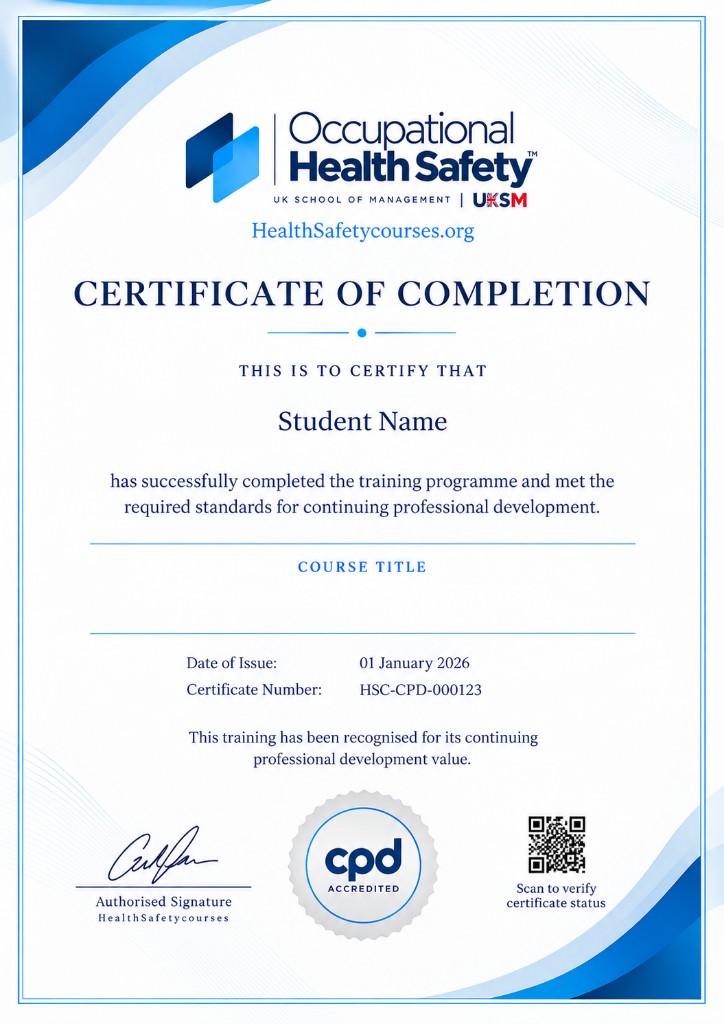
Upon successful completion of the course and assessment, participants will receive a certificate of completion in Effective Fire Prevention in Residential Settings.
- Unique certificate ID and QR code
- Online verification anyone can use
- Shows the course title, study hours and date for your CPD record
Sample certificate — Effective Fire Prevention in Residential Settings: Practical Implementation Techniques
 Effective Fire Prevention in Residential Settings: Practical Implementation Techniques
| Feature | This course | Level 3/4 fire risk assessment qualification |
|---|---|---|
| Best for | Assessing and reviewing your own workplace | Becoming a professional fire risk assessor |
| Recognition | Independent certificate, not regulated | Regulated qualification from an awarding body |
| Time | About 1–2 months part time | Several days of training plus assessed reports |
| Assessment | Online multiple choice | Exams and practical fire risk assessments |
| Start | Any day, fully online | Set course dates |
Course fees
Fire risk assessment course FAQs
What qualifications do I need to enrol in the Effective Fire Prevention in Residential Settings: Practical Implementation Techniques?
No specific prior qualifications are required. However, basic literacy and numeracy skills are essential for successful completion of the course.
How long does it take to complete the course?
The course is self-paced and flexible. Most learners complete it within 1 to 2 months by dedicating 4 to 6 hours per week.
Is this course accredited?
This course is not accredited by a recognised awarding body and is not regulated by an official institution. It is designed for personal and professional development and is not intended to replace or serve as an equivalent to a formal degree or diploma.
What support is available during the course?
This fully online programme includes comprehensive study materials and a range of support options to enhance your learning experience: - Online quizzes (multiple choice questions) - Audio podcasts (expert commentary) - Live student support via chat The course offers maximum flexibility, allowing you to study at your own pace, on your own schedule.
Can I study this course online?
Yes, the course is delivered entirely online with 24/7 access to learning materials. You can study at your convenience from any device with an internet connection.