Module 1: Introduction to Workplace Safety
This module provides an overview of the principles of workplace safety, including the importance of safety, the role of safety management, and the regulatory framework for workplace safety
This course provides a comprehensive understanding of workplace safety inspection and compliance. It is designed for professionals who want to ensure a safe and healthy work environment. The course covers the principles of workplace safety, hazard identification, risk assessment, and compliance with regulatory requirements. Participants will learn how to conduct safety inspections, identify hazards, and implement control measures to prevent accidents and injuries.
4.8/5
|217 reviews
|976 students enrolled
Comprehensive, industry-recognized certification that enhances your professional credentials
Self-paced online learning with 24/7 access to course materials for maximum flexibility
Practical knowledge and skills that can be immediately applied in your workplace
This module provides an overview of the principles of workplace safety, including the importance of safety, the role of safety management, and the regulatory framework for workplace safety
This module covers the principles of hazard identification and risk assessment, including the types of hazards, risk assessment methodologies, and control measures
This module provides you with practical frameworks and methodologies for conducting thorough risk assessments in various workplace settings. You'll learn evidence-based approaches to identify, evaluate, and prioritize potential hazards.
Effective risk assessment has been shown to reduce workplace injuries by up to 70% when implemented correctly, making this a critical skill for safety professionals.
This module provides an overview of the principles of safety inspection and compliance, including the types of safety inspections, compliance with regulatory requirements, and industry standards
This module covers the development and implementation of safety policies and procedures, including policy development, procedure writing, and training and education
This module provides an overview of the principles of monitoring and review of workplace safety, including performance metrics, monitoring and review techniques, and continuous improvement
This module covers the principles of investigation of accidents and incidents, including investigation methodologies, root cause analysis, and corrective actions
This programme includes comprehensive study materials designed to support your learning journey and offers maximum flexibility, allowing you to study at your own pace and at a time that suits you best.
You will have access to online podcasts with expert audio commentary.
In addition, you'll benefit from student support via automatic live chat.
Assessments for the programme are conducted online through multiple-choice questions that are carefully designed to evaluate your understanding of the course content.
These assessments are time-bound, encouraging learners to think critically and manage their time effectively while demonstrating their knowledge in a structured and efficient manner.
The demand for professionals with expertise in workplace safety is increasing, driven by the need for organizations to ensure a safe and healthy work environment. This course provides participants with the knowledge and skills to pursue a career in workplace safety, including roles such as safety officer, safety manager, and occupational health and safety specialist.
The field of workplace safety is constantly evolving, with new technologies, methodologies, and regulations emerging. Professionals with expertise in workplace safety can expect to have opportunities for career growth and development, including advancement to senior roles, specialization in specific areas, and opportunities for consulting and contracting.
Responsible for developing and implementing safety policies and procedures, conducting safety inspections, and providing training and education to employees
Responsible for managing the safety function, including development and implementation of safety policies and procedures, management of safety personnel, and budgeting and resource allocation
Responsible for developing and implementing programs to prevent workplace injuries and illnesses, including hazard identification, risk assessment, and control measures
In addition to these roles, professionals with expertise in workplace safety can also pursue opportunities in consulting, contracting, and education. They can also participate in professional associations and networks, and pursue certification and continuing education to stay up-to-date with the latest developments in the field.
Safety Manager
"I gained valuable knowledge on conducting thorough workplace safety inspections and identifying potential hazards, which I've already applied to improve our company's compliance with regulatory requirements. The course's focus on risk assessment and control measures has been particularly beneficial in reducing accidents at our site."
Occupational Health Specialist
"The course provided me with a comprehensive understanding of workplace safety principles and hazard identification techniques, enabling me to develop more effective safety protocols for our organization. I appreciated the emphasis on practical inspection methods and compliance with Japanese regulatory standards."
Environmental Health Officer
"The course helped me understand the importance of regular safety inspections and how to implement control measures to prevent accidents and injuries in the workplace. I've applied the knowledge gained from the course to improve our company's safety record and ensure compliance with Mexican labor laws and regulations."
Safety Consultant
"The course provided me with the skills and knowledge to conduct comprehensive safety inspections and identify potential hazards in various work environments. I've been able to apply the principles learned from the course to help my clients improve their safety compliance and reduce the risk of workplace accidents and injuries."
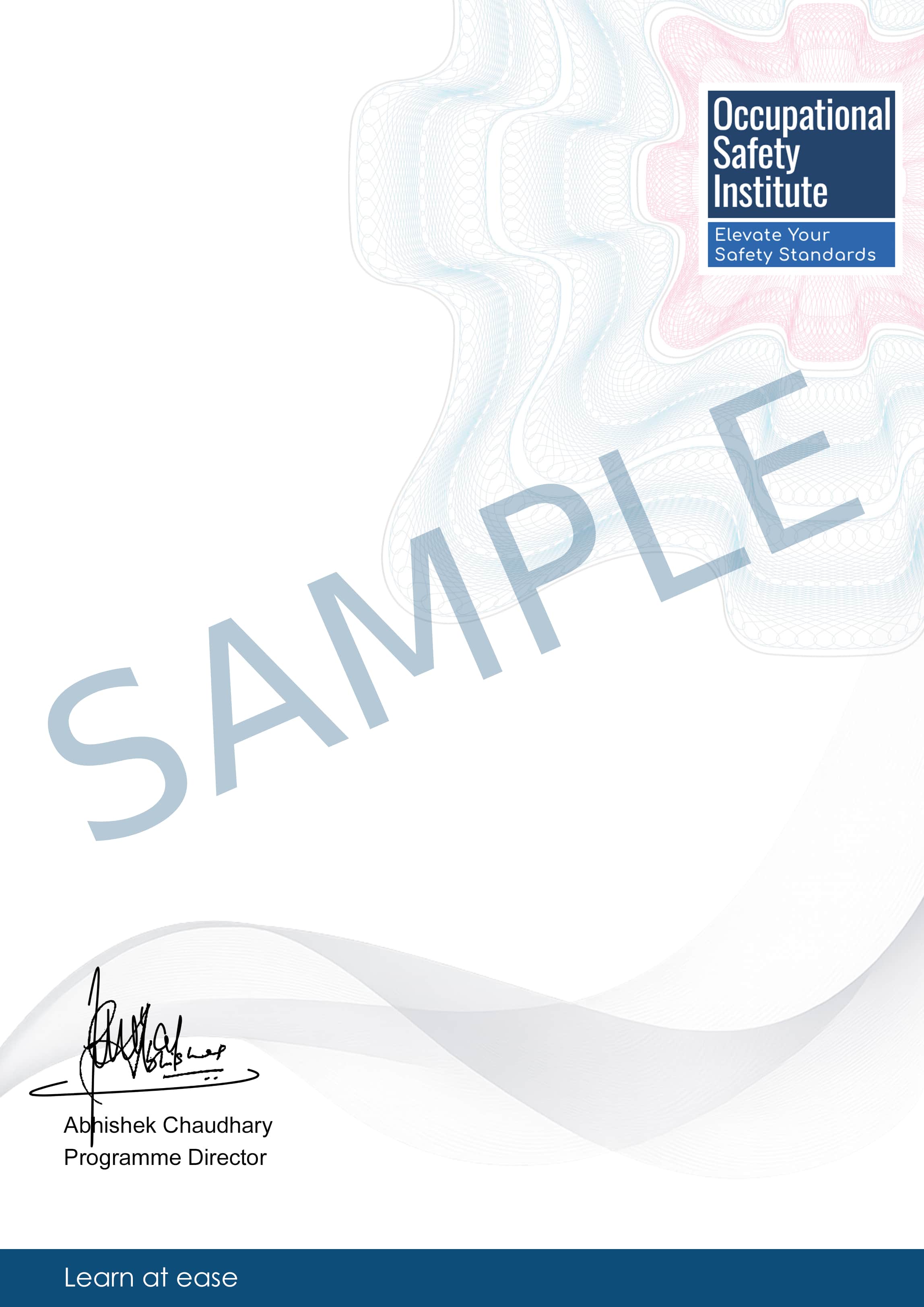
Upon successful completion of this course, you will receive a certificate similar to the one shown below:
No specific prior qualifications are required. However, basic literacy and numeracy skills are essential for successful completion of the course.
The course is self-paced and flexible. Most learners complete it within 1 to 2 months by dedicating 4 to 6 hours per week.
This course is not accredited by a recognised awarding body and is not regulated by an official institution. It is designed for personal and professional development and is not intended to replace or serve as an equivalent to a formal degree or diploma.
This fully online programme includes comprehensive study materials and a range of support options to enhance your learning experience: - Online quizzes (multiple choice questions) - Audio podcasts (expert commentary) - Live student support via chat The course offers maximum flexibility, allowing you to study at your own pace, on your own schedule.
Yes, the course is delivered entirely online with 24/7 access to learning materials. You can study at your convenience from any device with an internet connection.
RCAC Hazard Analysis and Control Training for Workplace Safety
Course about RCAC Hazard Analysis and Control Training for …
Implementing Effective ツムラ18 Safety Measures in the Workplace
This course provides a comprehensive overview of implementi…
キンキフキバッタ 西限 Safety Protocol Development and Implementation Training
Course about キンキフキバッタ 西限 Safety Protocol Development and Im…
協会けんぽ 医療費のお知らせ Training: Navigating Medical Expense Notifications for Health and Safety Professionals
This comprehensive course is designed for health and safety…
Disclaimer: This certificate is not intended to replace or serve as an equivalent to obtaining a formal degree or diploma. This programme is structured for professional enrichment and is offered independently of any formal accreditation framework.