Health and Safety Auditing Fundamentals: Conducting Effective Audits and Inspections Course
Learn how to plan, conduct and follow up basic health and safety audits and workplace inspections with defensible evidence.
- Duration
- Self-paced
- Access
- 6 months
- Assessment
- Online multiple choice
Course at a glance
- What it is
- An online risk assessment course with an independent certificate of completion.
- Who it's for
- Health and safety coordinators, quality staff, team leaders and internal auditors who need structured audit skills without assuming NEBOSH/IOSH qualification study.
- What you'll be able to do
- Apply what you learn in the course outcomes to your workplace.
- Time and cost
- Self-paced study. $199.99, one payment.
- Recognition
- This course is CPD-accredited by CPDcourses.org.uk. On successful completion, you receive a certificate of completion from healthsafetycourses.org. This is professional development training and is not an Ofqual-regulated qualification or an IOSH or NEBOSH award.
What you'll learn
By the end of the course you will be able to:
- Explain the purpose of health and safety audits within a management system.
- Develop an audit plan with scope, criteria, resources and timetable.
- Collect and record objective evidence during document review and site inspection.
- Classify findings and recommend proportionate corrective actions.
- Describe how to communicate results and verify close-out without bias.
Study materials and assessment
What's included
Self-paced online modules with audit planning and checklist examples within the course content. Access for up to six months from enrolment.
How you're assessed
Assessments for the programme are conducted online through multiple-choice questions that are carefully designed to evaluate your understanding of the course content. These assessments are time-bound, encouraging learners to think critically and manage their time effectively while demonstrating their knowledge in a structured and efficient manner.
Course modules
4 modules
Module 1: Audit purpose and UK legal context
Why organisations audit. Links to HASAWA 1974, MHSWR 1999 risk assessment and review cycles. Ethical behaviour and confidentiality.
- Audit vs inspection vs monitoring
- Roles of internal and external auditors
- Documentation proportionality
Module 2: Planning and criteria
Define scope, criteria and sampling. Prepare checklists mapped to hazards and controls for a chosen workplace scenario.
- Leading vs lagging indicators
- Competence of auditors
- Scheduling and notice
Module 3: Conducting the audit
Interview techniques, observation skills and triangulation of evidence. Common pitfalls: hindsight bias and checklist tourism.
- Photographs and notes
- Talking to frontline staff
- Contractor and temporary areas
Module 4: Reporting and follow-up
Grading findings, prioritisation, SMART actions and verification visits. When to escalate statutory non-compliance.
- Management review inputs
- Trend analysis
- Learning from repeat findings
The 5 steps to risk assessment
The structured approach our courses follow.
- Identify the hazardsLook for anything that could cause harm: tasks, equipment, substances, layout and working patterns.
- Decide who might be harmed and howInclude staff, visitors, contractors and people at higher risk, such as new or young workers.
- Evaluate the risks and decide on precautionsCompare what you already do with good practice and add controls where needed.
- Record your significant findingsWrite down the hazards, who is at risk and the controls. Required if you have five or more employees.
- Review and updateRevisit after changes, incidents or near misses, and at regular intervals.
Risk assessment and the law
- Management of Health and Safety at Work Regulations 1999Regulation 3 requires a suitable and sufficient assessment of risks. Employers with five or more employees must record the significant findings.
- Health and Safety at Work etc. Act 1974Sets the general duty to protect employees and others, so far as is reasonably practicable.
- Topic-specific regulationsCOSHH, manual handling, fire safety and work at height rules each require their own risk assessment.
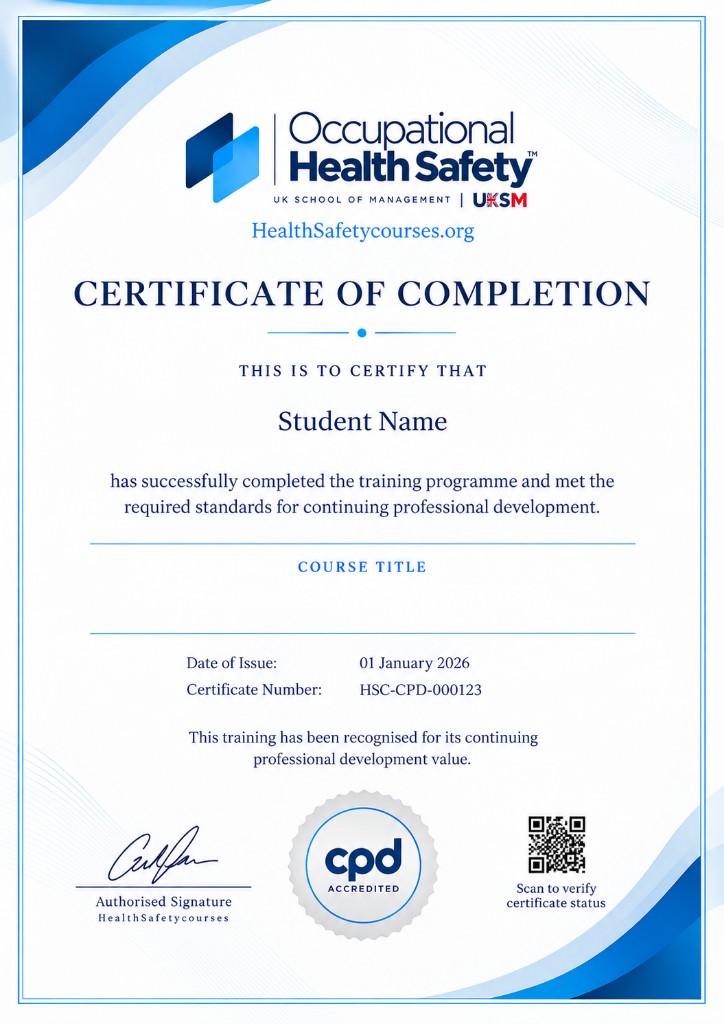
Your certificate
Digital certificate of completion issued by healthsafetycourses.org. This programme does not confer chartered status, NEBOSH/IOSH awards or external auditor registration.
- Unique certificate ID and QR code
- Online verification anyone can use
- Shows the course title, study hours and date for your CPD record
Sample certificate — Health and Safety Auditing Fundamentals: Conducting Effective Audits and Inspections
 Health and Safety Auditing Fundamentals: Conducting Effective Audits and Inspections
| Feature | This course | NEBOSH / IOSH |
|---|---|---|
| Best for | Workplace training and CPD records | Roles that name NEBOSH or IOSH in the job advert |
| Recognition | Independent certificate, not regulated | Regulated qualifications from awarding bodies |
| Time | Self-paced part time | From a few days (IOSH) to many months (NEBOSH diplomas) |
| Assessment | Online multiple choice | Exams, assignments and sometimes workplace projects |
| Start | Any day, fully online | Set course dates at training centres or online cohorts |
Course fees
Health and Safety Auditing Fundamentals: Conducting Effective Audits and Inspections course FAQs
Will this qualify me as a lead auditor?
No. It teaches fundamentals for workplace audits. External certification schemes have separate entry requirements.
How is this different from the Effective Auditing Techniques course?
This course covers core audit steps for coordinators. The Techniques course goes deeper on compliance programmes and implementation.
Is the assessment practical?
Assessment is online multiple-choice based on course material. Practical audit experience must be gained in your workplace.