
Risk Assessment and Hazard Control in Mechanical Engineering Practices Course
This course provides a comprehensive overview of risk assessment and hazard control in mechanical engineering practices, covering the main principles, methods, and techniques for identifying, evaluating, and controlling hazards in mechanical engineering. It is designed for mechanical engineers, safety professionals, and other individuals responsible for ensuring the safety of mechanical systems and equipment. The course is unique in its focus on practical, real-world applications and provides participants with the knowledge and skills necessary to develop and implement effective risk assessment and hazard control strategies. Key benefits for participants include improved safety performance, reduced risk of accidents and injuries, and enhanced career opportunities.
- Duration
- ~1–2 months
- Access
- 6 months
- Assessment
- Online multiple choice
Course at a glance
- What it is
- An online risk assessment course with an independent certificate of completion.
- What you'll be able to do
- Apply what you learn in the course outcomes to your workplace.
- Time and cost
- About 1–2 months. $199.99, one payment.
- Recognition
- This course is CPD-accredited by CPDcourses.org.uk. On successful completion, you receive a certificate of completion from healthsafetycourses.org. This is professional development training and is not an Ofqual-regulated qualification or an IOSH or NEBOSH award.
What you'll learn
By the end of the course you will be able to:
- Identify hazard types in mechanical engineering systems and equipment and explain why structured risk assessment and hazard control are used in this context.
- Compare hazard identification and risk evaluation techniques covered for mechanical engineering, including HAZOP, FMEA, and risk assessment matrices.
- Distinguish qualitative and quantitative risk assessment approaches taught in the course and outline hazard control methods aligned with assessed mechanical engineering risks.
- Describe safety culture, leadership, and communication practices and how ISO 45001 and related safety management system topics introduced in the syllabus relate to mechanical engineering hazard control.
- Use the course case studies, practical exercises, and final-project materials to outline a risk assessment and hazard control plan for a mechanical engineering scenario.
Study materials and assessment
What's included
This programme includes comprehensive study materials designed to support your learning journey and offers maximum flexibility, allowing you to study at your own pace and at a time that suits you best. You will have access to online podcasts with expert audio commentary. In addition, you'll benefit from student support via automatic live chat.
How you're assessed
Assessments for the programme are conducted online through multiple-choice questions that are carefully designed to evaluate your understanding of the course content. These assessments are time-bound, encouraging learners to think critically and manage their time effectively while demonstrating their knowledge in a structured and efficient manner.
Course modules
6 modules
Module 1: Introduction to Risk Assessment and Hazard Control
This module provides an overview of the principles and methods of risk assessment and hazard control, including the importance of these practices in mechanical engineering. Participants will learn about the different types of hazards that can occur in mechanical engineering systems and equipment, as well as the methods and techniques used to identify, evaluate, and control these hazards.
- Introduction to risk assessment and hazard control
- Types of hazards in mechanical engineering
- Methods and techniques for identifying hazards
- Methods and techniques for evaluating risks
- Introduction to safety management principles and methods
Module 2: Hazard Identification and Risk Evaluation
This module provides a detailed overview of the methods and techniques used to identify and evaluate hazards in mechanical engineering systems and equipment. Participants will learn about the different types of hazard identification techniques, including hazard and operability studies (HAZOP) and failure mode and effects analysis (FMEA).
- Hazard identification techniques
- Risk evaluation methods
- Hazard and operability studies (HAZOP)
- Failure mode and effects analysis (FMEA)
- Introduction to risk assessment matrices
Module 3: Risk Assessment and Hazard Control Strategies
This module provides a comprehensive overview of the strategies and methods used to assess and control risks in mechanical engineering systems and equipment. Participants will learn about the different types of risk assessment strategies, including qualitative and quantitative risk assessment, as well as the methods and techniques used to implement these strategies.
- Risk assessment strategies
- Qualitative risk assessment
- Quantitative risk assessment
- Introduction to hazard control methods
- Introduction to safety management systems
Module 4: Safety Management Principles and Methods
This module provides a detailed overview of the principles and methods of safety management, including the importance of safety culture, safety leadership, and safety communication. Participants will learn about the different types of safety management systems, including ISO 45001, as well as the methods and techniques used to implement these systems.
- Introduction to safety management principles
- Safety culture and safety leadership
- Safety communication and safety training
- Introduction to safety management systems
- ISO 45001 and other safety management standards
Module 5: Case Studies and Practical Exercises
This module provides participants with the opportunity to apply the knowledge and skills gained in the course to real-world scenarios. Participants will work in groups to complete case studies and practical exercises, and will receive feedback from the instructor on their performance.
- Case study 1: Hazard identification and risk evaluation
- Case study 2: Risk assessment and hazard control strategies
- Practical exercise 1: Developing a risk assessment and hazard control plan
- Practical exercise 2: Implementing a safety management system
- Group discussion and feedback
Module 6: Final Project
This module provides participants with the opportunity to develop a comprehensive risk assessment and hazard control plan for a mechanical engineering project. Participants will work individually to complete the project, and will receive feedback from the instructor on their performance.
- Introduction to the final project
- Developing a risk assessment and hazard control plan
- Implementing a safety management system
- Presenting the final project
- Receiving feedback and evaluation
The 5 steps to risk assessment
The structured approach our courses follow.
- Identify the hazardsLook for anything that could cause harm: tasks, equipment, substances, layout and working patterns.
- Decide who might be harmed and howInclude staff, visitors, contractors and people at higher risk, such as new or young workers.
- Evaluate the risks and decide on precautionsCompare what you already do with good practice and add controls where needed.
- Record your significant findingsWrite down the hazards, who is at risk and the controls. Required if you have five or more employees.
- Review and updateRevisit after changes, incidents or near misses, and at regular intervals.
Risk assessment and the law
- Management of Health and Safety at Work Regulations 1999Regulation 3 requires a suitable and sufficient assessment of risks. Employers with five or more employees must record the significant findings.
- Health and Safety at Work etc. Act 1974Sets the general duty to protect employees and others, so far as is reasonably practicable.
- Topic-specific regulationsCOSHH, manual handling, fire safety and work at height rules each require their own risk assessment.
Your certificate
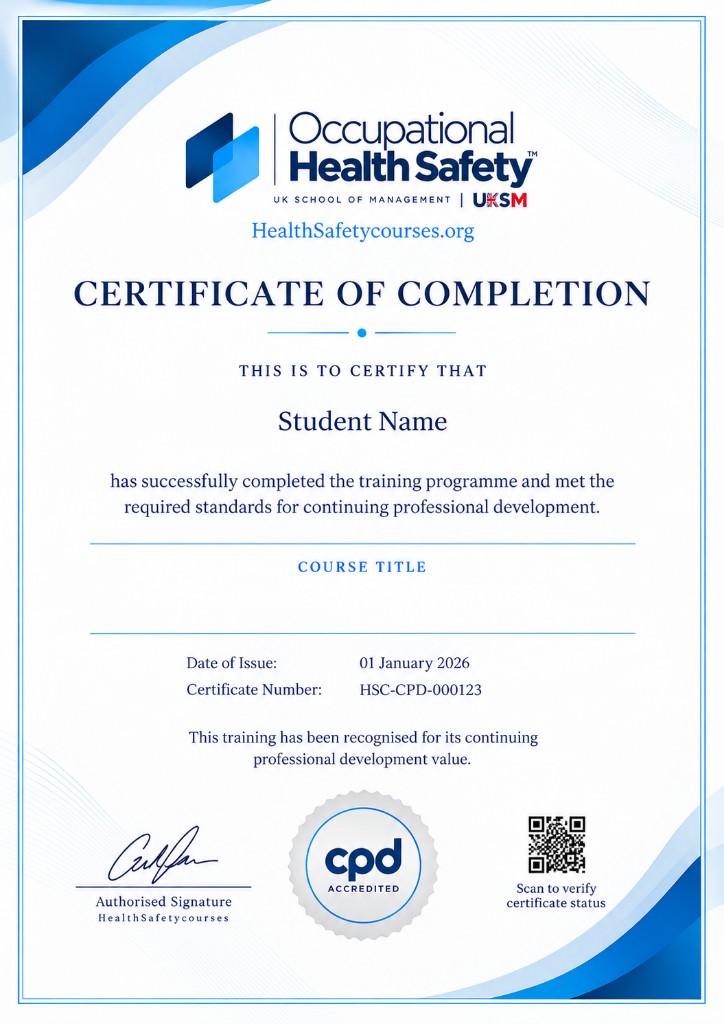
Participants who complete the course will receive a certificate of completion, and may be eligible to apply for professional certification in safety management.
- Unique certificate ID and QR code
- Online verification anyone can use
- Shows the course title, study hours and date for your CPD record
Sample certificate — Risk Assessment and Hazard Control in Mechanical Engineering Practices
 Risk Assessment and Hazard Control in Mechanical Engineering Practices
| Feature | This course | NEBOSH / IOSH |
|---|---|---|
| Best for | Workplace training and CPD records | Roles that name NEBOSH or IOSH in the job advert |
| Recognition | Independent certificate, not regulated | Regulated qualifications from awarding bodies |
| Time | About 1–2 months part time | From a few days (IOSH) to many months (NEBOSH diplomas) |
| Assessment | Online multiple choice | Exams, assignments and sometimes workplace projects |
| Start | Any day, fully online | Set course dates at training centres or online cohorts |
Course fees
Risk Assessment and Hazard Control in Mechanical Engineering Practices course FAQs
What qualifications do I need to enrol in the Risk Assessment and Hazard Control in Mechanical Engineering Practices?
No specific prior qualifications are required. However, basic literacy and numeracy skills are essential for successful completion of the course.
How long does it take to complete the course?
The course is self-paced and flexible. Most learners complete it within 1 to 2 months by dedicating 4 to 6 hours per week.
Is this course accredited?
This course is not accredited by a recognised awarding body and is not regulated by an official institution. It is designed for personal and professional development and is not intended to replace or serve as an equivalent to a formal degree or diploma.
What support is available during the course?
This fully online programme includes comprehensive study materials and a range of support options to enhance your learning experience: - Online quizzes (multiple choice questions) - Audio podcasts (expert commentary) - Live student support via chat The course offers maximum flexibility, allowing you to study at your own pace, on your own schedule.
Can I study this course online?
Yes, the course is delivered entirely online with 24/7 access to learning materials. You can study at your convenience from any device with an internet connection.